Personalized learning plan: stop wasting time on irrelevant training

Customer Success Coach & Projectmanager at FLOWSPARKS
In a world where technology evolves at breakneck speed, customer expectations are constantly shifting, and the war for talent is in full swing, standing still means falling behind. As a result, employees must continuously develop their skills to meet the demands of their roles.
The solution? A personalized learning plan. This is the most effective way to align individual employee goals with organizational objectives.
In this article, you’ll learn:
- what personalized learning plans are
- why they matter for your employees and your business
- which key features make a learning plan effective (and scalable)
- which learning models can power personalized learning paths
- how to create a personalized learning plan for employees
- and real examples of personalized learning in training
Side note: When we refer to a participant in this article, we also mean a student, trainee, learner, or employee.
What are personalized learning plans?
A personalized learning plan, also known as a personalized learning path, is an approach that creates an individualized pathway for each participant. This plan is built on unique factors such as existing skills, knowledge gaps, and learning styles.
Moreover, personalized learning paths are tailored learning journeys that align with the unique needs, preferences, and styles of each individual participant. Unlike a one-size-fits-all approach, these paths offer a customized flow through various learning activities. The activities are logically structured, with each phase building on the previous one, ensuring a coherent and progressive learning experience. This includes the integration of diverse learning methods, such as e-learning courses, webinars, workshops, coaching sessions, and on-the-job training.
A few terms: differentiated, personalized, and adaptive learning
Although the terms differentiated learning, personalized learning, and adaptive learning are closely related, they are not synonymous. Let’s look at the difference:
Differentiated learning
Differentiated learning works with a limited number of different, predefined learning routes. These routes share the same learning objective but vary in approach and level to better accommodate differences in ability or experience. A typical example is an onboarding program for new employees.
For everyone, the goal is to become familiar with the organization and their role. However, the learning route may differ for various job groups.
The learning routes can start with a generic section, after which the different job groups continue with assignments tailored to their specific role and level.
Personalized learning
Personalized learning goes a step further and focuses on individual learning routes. Often based on formative assessment results (such as a diagnostic entry assessment), it determines the most effective way for a specific employee to progress. The personalization lies in the level of difficulty and the learning style, tailored to the individual participant. Typically, the participant has (to a greater or lesser extent) control over how and at what pace the learning journey is completed.
An example is an onboarding program for a specific job group, where the new employee can choose a learning format that best matches their personal needs.
Adaptive learning
Adaptive learning is, in a sense, both differentiated and personalized, but it is fundamentally data-driven. Intelligent software tracks the results and progress of each individual employee in real time using algorithms. Based on this collected data, the learning content is adjusted in real time to what best suits the participant at that moment, taking into account level, learning style, and preferences.
Research backs this: Meta-analyses of intelligent tutoring systems and other adaptive learning approaches show meaningful improvements in learning outcomes compared with non-adaptive instruction.
What is needed to create these types of learning? Differentiated and personalized learning can be delivered through a Learning Management System (LMS). For delivering adaptive learning, organizations often choose a Learning Experience Platform (LXP).
The importance of a personalized learning plan
Why invest time and resources in customized learning paths? Because personalized learning leads to more relevant, engaging, and, most importantly, effective training.
1. Increased productivity
Personalized learning plans improve productivity by reducing wasted learning time. Employees focus on the skills they actually need, skip what they already know, and get targeted practice and feedback, helping them reach proficiency faster and perform more consistently.
2. Develop skills more efficiently
By focusing on specific goals and competencies, employees develop relevant skills faster and more efficiently. A personalized learning plan helps new hires and employees who are upskilling get up to speed quickly by skipping what they already know and concentrating on what matters most. This significantly shortens the time to proficiency.
3. Higher engagement and motivation
Participants are more engaged when content is tailored to their role, experience level, and career ambitions.
4. Stronger talent development and retention
A robust learning platform is an attractive employment benefit. It shows that you invest in development, crucial for attracting and retaining top talent.
5. Flexibility and future readiness
Through an LMS, authoring tool or LXP, you can quickly respond to market changes, new regulations, or the introduction of new tools with up-to-date learning modules and microlearning. And that’s not a luxury: according to the World Economic Forum, a large share of employees’ skills will be reshaped in the coming years, making targeted reskilling and upskilling essential.
Key features of a personalized learning plan
An effective learning path is a structured roadmap that guides competency development. These are the key characteristics of an effective learning plan:
Key features:
- Alignment with organizational goals: It connects the participant’s development to the company’s objectives.
- Personalization: It provides a tailored learning plan based on specific roles and development needs.
- Integration of multiple learning methods: Combining formal training, on-the-job learning, and microlearning.
- Clear objectives and milestones: Defining what success looks like at each stage.
- Opportunities for feedback and support: Ensuring continuous improvement and learner engagement.
Which Technological Components Do You Need for Personalization?
Modern platforms make personalization scalable through technology. Essential components of a personalized learning program include:
- Learner profiles: Capturing individual data such as job role, prior experience, knowledge gaps, and learning preferences to tailor learning paths.
- Adaptive learning paths: Replacing static training programs with paths that adjust based on progress and assessment results.
- Competency-based progression: Participants advance only after demonstrating mastery of the material, reducing cognitive overload and improving retention.
Learning models for personalized learning paths
Learning models collect and analyze data on how a participant learns, such as pace, prior knowledge, interests, frequently made mistakes, and motivation. Based on this information, personalized learning paths can be developed that make learning more tailored, effective, and enjoyable, for both participants and instructors.
This ultimately leads to:
- Higher learning outcomes: Participants receive exactly what they need: neither too easy nor too difficult.
- Better motivation: The learning path aligns with interests and learning style, keeping participants engaged.
- More efficient learning: Less time is wasted on unnecessary repetition or overly challenging material.
- Support for instructors: Instructors gain insight into where participants struggle and can provide more targeted guidance.
Below are several examples of learning models you can apply to create personalized learning paths.
1. Competency-based learning (CBE) / Mastery learning
Core principle: Participants only progress once they have truly mastered a skill. Progress is based on mastery, not time. This is supported by meta-analytic evidence on mastery learning, which shows positive effects on performance when learners progress based on demonstrated mastery.
Key characteristics:
- Individual pace
- Clear learning objectives (“competencies”)
- Feedback and opportunities for repetition
2. Blended learning
Core principle: A combination of online learning and face-to-face instruction, often personalized through digital tools.
Variants:
- Flipped classroom: Participants watch instructional videos at home and use class time for practice and guidance.
- Station rotation model: Participants rotate between digital stations, group work, and direct instruction.
Research also backs this up: this meta-analysis, commissioned by the U.S. Department of Education, shows that blended learning delivers better learning outcomes than classroom-only instruction in many studies, provided it is well designed.
3. Individualized learning plans (ILPs) / Personalized learning paths
Core principle: Each participant has a personalized learning plan that outlines their goals, strengths, and areas for development.
4. Mentor- or advisory-based models
Core principle: Each participant has a coach or mentor who discusses personal progress and supports goal-setting and reflection.
How do you create a personalized learning path for employees with FLOWSPARKS?
You create a personalized learning path for employees by systematically determining what someone needs to learn, how that person learns best, and when that knowledge is most relevant. To achieve this, it is important to go through the following four steps:
1. Identify learning needs
Analyze which knowledge and skills an employee requires based on job requirements, organizational goals, and individual ambitions. Use assessments, conversations, and performance data to do so.
2. Determine the starting level and learning style
Assess what the employee already knows and which learning approach works best (for example, hands-on, self-directed, or guided). Evidence reviews caution against rigid ‘learning styles’ matching; instead, it’s usually better to rely on observed performance, learner preferences, and assessment data. This helps ensure the learning path aligns well with the individual.
3. Select appropriate learning activities
Choose learning formats that match both the needs and preferences, such as microlearning, e-Learning, coaching, workshops, projects, or on-the-job assignments. Combine these into a logical and achievable route.
4. Monitor, evaluate, and adjust
Track progress using data, feedback, and regular evaluations. Adjust the learning path when goals change, skills grow, or new opportunities arise.
Personalization with FLOWSPARKS
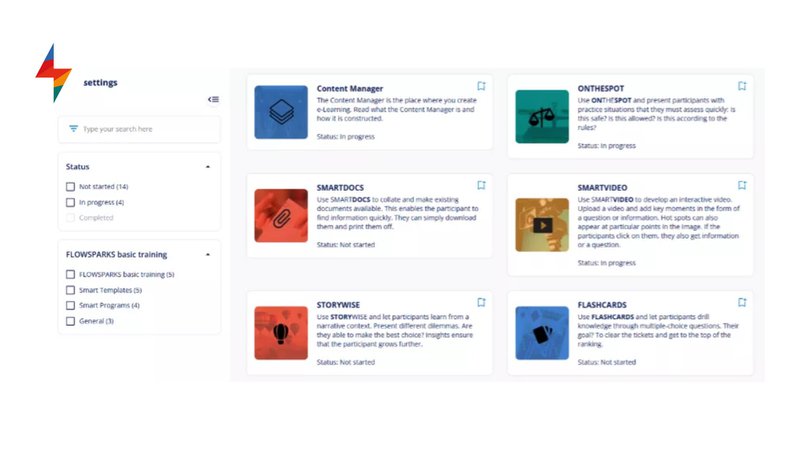
FLOWSPARKS offers specific solutions that enable personalized and adaptive learning experiences, supporting both content creation and the management of learning journeys.
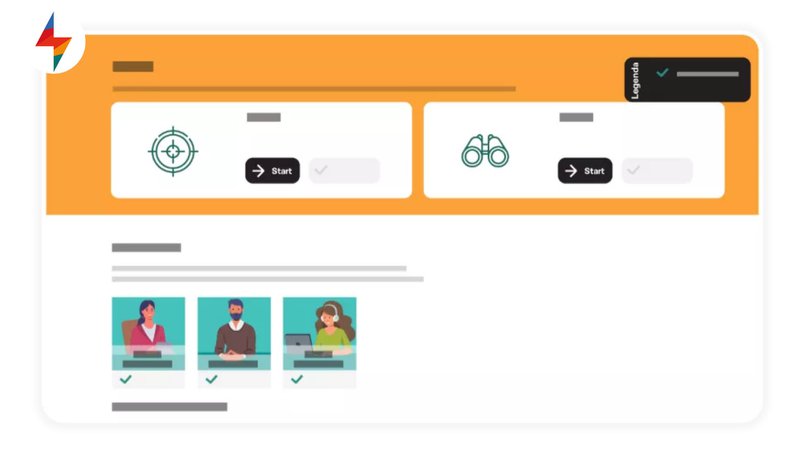
Adaptive learning programs
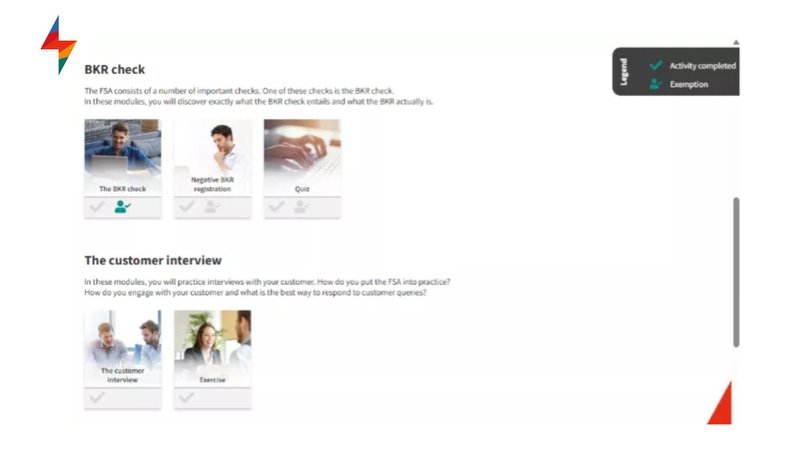
The process begins with an intake assessment to determine prior knowledge and learning needs. Learners with extensive experience receive exemptions and can complete the program in less time, with learning activities tailored to the results of their personal assessment.
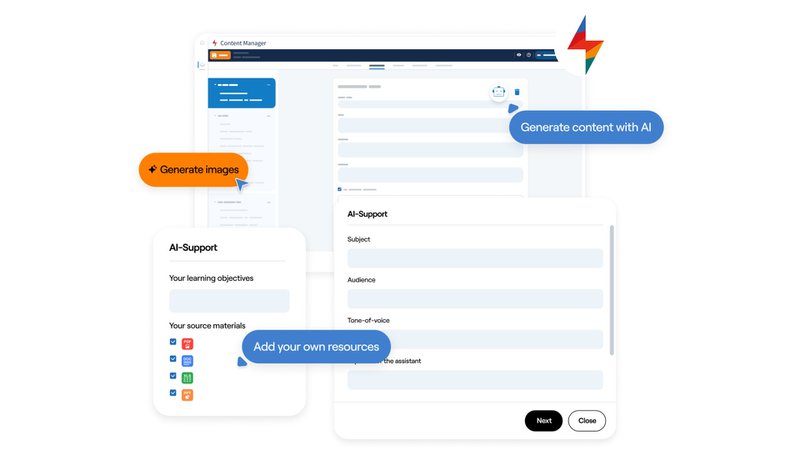
AI-based generation of e-Learning
FLOWSPARKS offers an AI-based Co-Author feature. By providing input on the target audience and learning objectives, and uploading source material, the Co-Author can create a didactically structured template, an ideal starting point for developing your learning path.
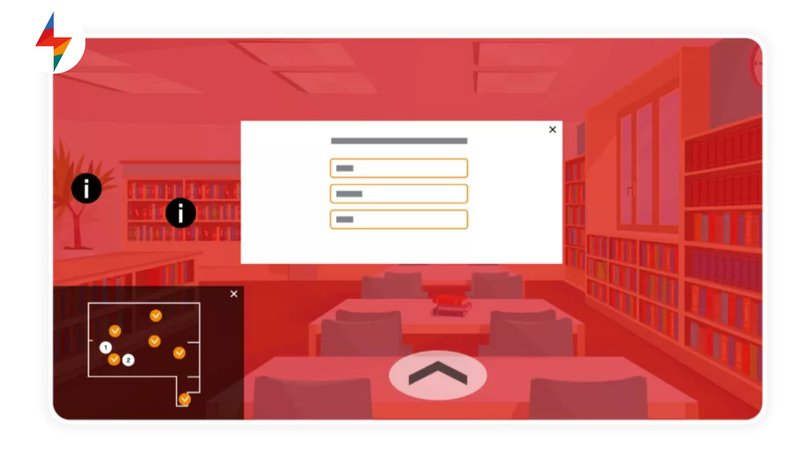
Immersive experiences
For practice-oriented training, you can create a learning activity which contributes to realistic, hands-on training experiences.
Catalog
This allows participants to freely choose learning activities. Optionally, together with a coach, it can be determined how the learner’s personal learning path can be further enriched, in line with the individual learner’s learning needs.
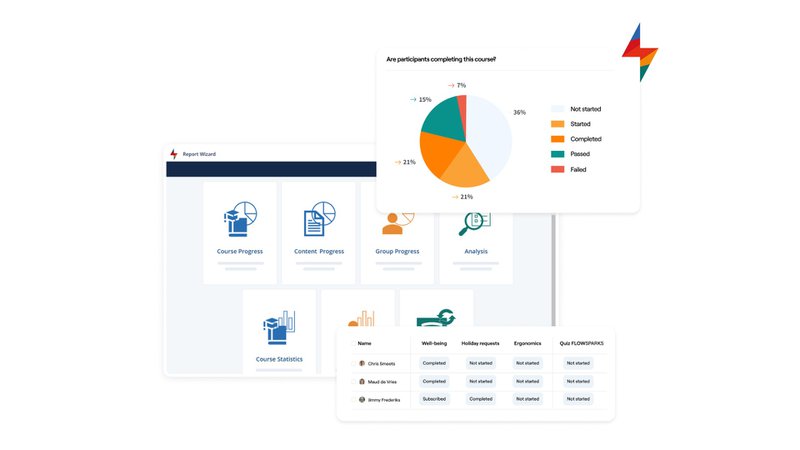
LMS features
FLOWSPARKS also provides LMS functionalities for the distribution, reporting, and administration of e-learning. This data can be used to further optimize and personalize your learning paths.
Examples of personalized learning in training
Concrete examples of a personalized learning plan developed with FLOWSPARKS:
Refresher training within a large telecom organization
Employees begin their learning path with an adaptive intake test. This test allows them to demonstrate which knowledge they still master. Based on the results, employees earn exemptions, enabling them to complete the learning path more quickly.
Learning path for starting project managers
A learning path with a wide range of practical assignments. Together with an assigned mentor, employees determine which assignments are relevant for them. The assignments are completed and submitted with in the e-Learning program. The mentor reviews the submissions, and only after approval can the employee continue with the learning path.

Best practices for implementing a personalized learning plan
To successfully implement personalized learning, you can follow these best practices:
1. Assess learning needs and preferences
Start by collecting data on your audience’s current competencies, learning needs, and preferences.
2. Use AI-powered authoring tools
Leverage AI-driven tools to create high-quality e-learning efficiently. These tools help you develop didactically sound content faster and align it with employees’ skill levels and learning needs.
3. Maintain the human element
While AI supports e-learning development, the quality of AI-generated content must be carefully reviewed and adjusted where necessary.
4. Offer practice-oriented experiences
In addition to e-learning, employees need hands-on experience. Provide simulations, case studies, and collaborative projects that reflect real-world scenarios, allowing employees to practice safely without risk.
5. Create a continuous learning culture
Make learning flexible and accessible so it becomes an ongoing part of the workday. Use microlearning, repetition exercises, and easily accessible resources.
6. Monitor continuously and stay flexible
Measure the effectiveness of your e-Learning and personalized learning paths. Use LMS reports, evaluate learning paths with your audience, and track employee progress. Be ready to adapt and improve learning paths as needed.
Conclusion
Transitioning to personalized learning plans is essential to futureproof your organization. By offering tailored learning paths, L&D professionals can move from generic learning solutions to personalized and adaptive growth journeys.
Frequently Asked Questions (FAQ)
What is a personalized learning plan?
A personalized learning plan is a tailored route for an individual employee, outlining specific learning objectives, resources, and timelines. It is designed to meet the learner’s unique needs, skills, and preferences, often supported by AI technology.
Why are personalized learning plans important?
They are crucial because they significantly increase employee engagement, motivation, and knowledge retention. By addressing specific skill gaps and roles, they lead to more efficient competency development, faster time-to-proficiency, and higher productivity.
How do you create a personalized learning plan?
Follow these five steps:
- Define goals and identify employees’ learning needs.
- Identify available resources.
- Set SMART goals, prioritize learning needs, and design a high-level learning path.
- Develop your learning path using a suitable authoring tool.
- Continuously monitor progress and evaluate results to adjust learning paths as needed.
.avif)
Are you looking to step up your digital training efforts
inside your organization?
Schedule a demo and discover how FLOWSPARKS helps create and deliver engaging e-Learning experiences backed by strong instructional design principles in multiple languages without a hassle.
More interesting reads
.avif)
Best learning management systems in 2026: how to choose
Top 10 e-Learning authoring tools in 2026