Adaptive learning in corporate training: boost your training efficiency

Customer Success Coach at FLOWSPARKS
As an L&D specialist, you’ve probably run into this challenge: you design a well-structured training program, but after the first sessions it becomes clear that one participant thinks it’s too easy, while another is still struggling with the basics. You try to balance pace, relevance, and quality, but you simply can't meet everyone’s needs when every learner follows the exact same path.
Instead of pushing everyone through the same program, wouldn’t it be much more efficient and pleasant to offer a personalized learning journey that matches each employee’s level and needs?
That’s exactly what adaptive learning makes possible in corporate training.
In this article, you’ll discover:
- what adaptive learning actually is,
- why traditional training often falls short,
- the benefits (and pitfalls) of adaptive learning,
- how to apply it in your organization,
- and how FLOWSPARKS brings these principles to life in practice.
1. What is adaptive learning?
Adaptive learning literally means learning that adapts. The idea originally comes from education, where technology was used to support learners at different levels.
In a corporate context, adaptive learning means that the learning journey adjusts based on:
- an employee’s existing knowledge (what do they already know?),
- their learning preferences and pace,
- and sometimes even their behaviour or performance during the program.
The foundation is data: through tests, interactions, or user choices, the learning program determines what is relevant for that individual. This ensures a learning experience that is neither too easy nor too difficult.
In practice, this may look like:
- an intake test that determines which modules you can skip,
- extra exercises when you struggle with specific topics,
- or a shortened program if you’re already an expert.
The result? No more time wasted on what you already know, and no more frustration because the training moves too fast.
2. Why traditional training methods / non-adaptive training miss(es) the mark
Traditional corporate training often assumes one learning path for everyone. While this may seem efficient at first glance, it rarely is in reality.
Take a compliance training: some employees are completing it for the tenth time, while others are taking it for the very first time. Yet they all have to go through the same duration, the same examples... and the same test.
The result: experienced employees perceive this as a waste of time, and newcomers can easily feel overwhelmed. Ultimately, this leads to lower knowledge retention for everyone.
Traditional training misses the personal relevance needed to keep learners engaged. It treats knowledge as a checkbox: “Everyone must have seen this.” Adaptive learning flips that: “What does this specific person need to perform better?”
3. Benefits of adaptive learning in corporate training
Adaptive learning brings the power of personalization into the workplace. Below are the main benefits, for both learners and the organization.
1. Learning stays relevant
Every employee receives exactly the content that matches their level and role. No information overload, no wasted time.
And that bears its fruits: this meta-analysis of adaptive training interventions found that adaptive difficulty, guided support, and test-out/remediation can improve learning outcomes compared to non-adaptive instruction.
2. Reduced learning time, increased efficiency
Those with prior knowledge skip repetition. Those who struggle receive additional support.
3. Higher motivation and engagement
Experienced staff appreciate that their expertise is recognized, while new employees feel supported at their own pace.
4. Data-driven insights
Adaptive learning technology generates valuable data about knowledge gaps, progress, and patterns. This helps L&D managers make better decisions about where to focus attention.
5. Business impact
Faster learning means faster application. If employees spend less time in training, they spend more time doing their job. Adaptive learning boosts not only the learning experience, but also the ROI of your training efforts.
CIPD’s Learning at Work research shows that addressing skills gaps is the number one priority for many L&D specialists, making time-efficient, targeted learning paths a direct business advantage.
4. Possible disadvantages of adaptive learning in corporate training
As with any innovation, there are considerations to keep in mind. Adaptive learning does not run itself: it requires thoughtful implementation.
Complexity in development
A strong adaptive learning journey starts with a solid structure: clear learning objectives, levels, and well-designed question types. Preparation takes time.
Dependence on data
Adaptive learning is only as good as the data behind it. Poorly designed question banks or superficial assessment items may undermine the validity of exemptions.
Less group cohesion
When everyone learns at their own pace, the social aspect of learning may diminish. Solution: combine adaptive e-learning with group sessions or peer feedback.
Initial investment
It requires upfront time and strategic thinking, but pays off through efficiency, higher learning effectiveness, and lower long-term maintenance.
In short: adaptive learning requires preparation, but delivers exponential return.
5. How to use adaptive learning in corporate training
1. Start with the right technology and approach
The core of adaptive learning is technology that tracks each participant’s progress and responds accordingly. This can be as simple as an intake test or as advanced as AI-powered solutions that automatically tailor content to the learner. What matters is matching the tool to your goal: do you want to measure knowledge, influence behaviour, or build skills? A good alignment between objective and technology determines success.
2. Build on existing knowledge, not over it
Just like you can’t place a roof without a foundation, you can’t build new knowledge without understanding what already exists. Adaptive learning helps map this foundation.
If an employee already masters the basics, you can speed up the process or skip parts. If not, they receive extra explanation, examples, or exercises, ensuring neither boredom nor frustration.
3. Think beyond difficulty level
Adaptive learning is not only about scaling content up or down. It considers learning styles and context, too.
Some employees learn visually, others step-by-step, others through hands-on practice. Modern platforms allow variation through videos, scenarios, quizzes, infographics, and cases.
Accessibility matters as well: alternative fonts, subtitles, or text-to-speech options.
4. Follow adult learning principles
Adaptive learning works best when aligned with adult motivation: relevance, autonomy, and real-life application.
Ensure that you:
- link content to real daily situations,
- allow learners to make choices in their learning path,
- provide regular reflection and feedback moments.
This turns technology into a truly meaningful learning experience.
5. Train your trainers
Whether the program is self-paced or guided, trainers must understand and support the adaptive system. They help learners see its value, especially if this approach is new.
A short train-the-trainer session on how adaptive modules work (and what they measure) prevents resistance and ensures consistency.
6. Evaluate and improve continuously
Adaptive learning doesn’t stop after implementation. Because you collect so much data, evaluation becomes essential.
Look for patterns: Where do people drop off? Which sections are frequently skipped? Which questions cause difficulties?
Use these insights to refine your content or create targeted follow-up training. Every cycle becomes better than the last.
6. Examples of adaptive learning
Adaptive learning doesn’t require AI to predict every click.
With the right FLOWSPARKS tools, you can apply adaptive principles today.
Here are four examples:
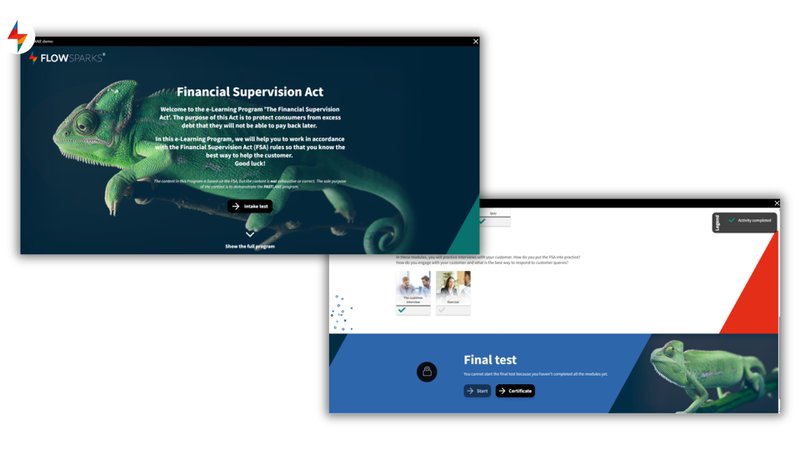
Adaptive pathway program
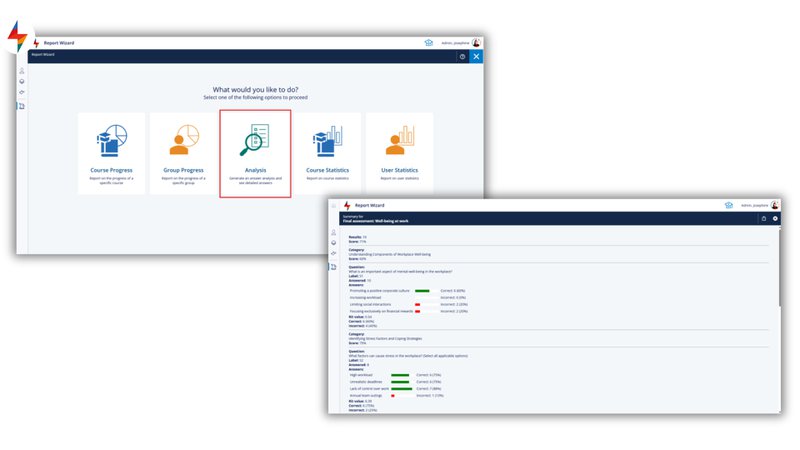
Through an intake test, the program automatically determines which parts the learner must follow and which can be skipped, creating a tailored learning journey.
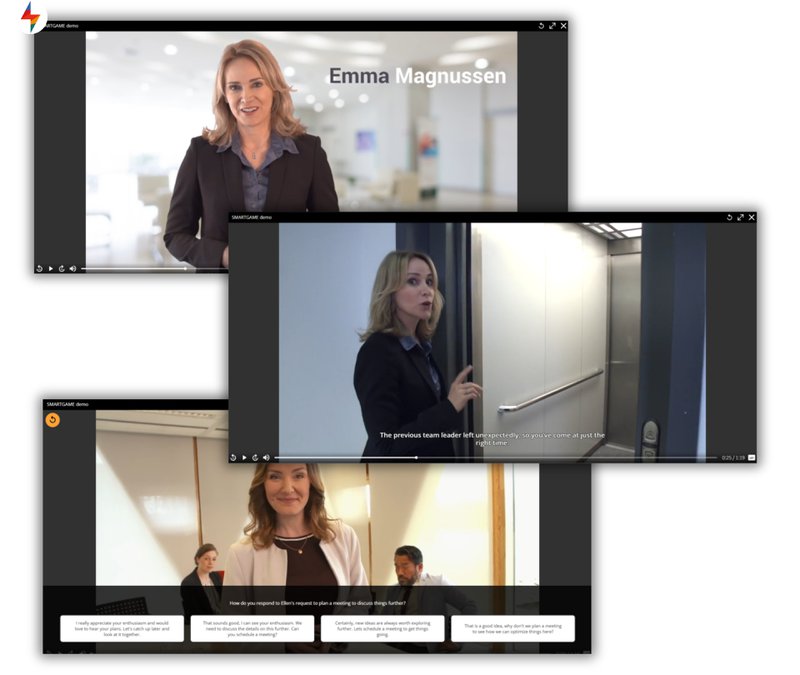
Scenario-based video learning: adaptive scenarios and choices
FLOWSPARKS allows you to build interactive scenarios where every decision leads to a different outcome. Learners experience the impact of their choices with context-specific feedback.
Perfect for soft skills, safety, or customer-facing situations.
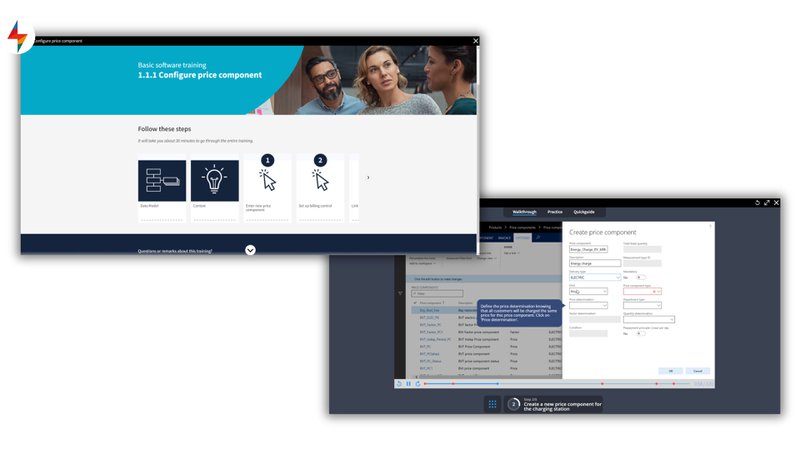
Microlearnings: flexible and self-paced
FLOWSPARKS makes it easy to divide content into short microlearnings that learners follow at their own pace and in their own sequence. This boosts autonomy and creates a simple form of adaptivity without complex logic.
BCG’s whitepaper points out that implementing personalized learning at scale often requires smaller, flexible learning units that can be combined to meet individual requirements, exactly what microlearning enables.
Learning data insights: adaptivity through analysis
By analysing learning data (“Where do people struggle?”, “Which questions cause issues?”), you can refine your program and tailor follow-ups. Adaptivity becomes part of both the learning journey and the continuous improvement afterwards.
7. BASF case: cutting recertification time in half with adaptive learning
At BASF, employees working with respiratory protection systems must renew their certification every five years. This affects 1,700 employees, of whom 350–400 must recertify each year. Many work in shifts, which limits their time at a computer.
Respiratory protection was one of the first topics BASF digitized into e-learning. The shift from classroom training to online learning was well received, but spending 1–1.5 hours inside a topic overview page (with multiple interactive activities) was too time-consuming, especially for long-tenured employees who didn’t need to review all content to reach the final test.
FLOWSPARKS introduced an alternative: a shorter, adaptive program in which employees only receive the content they actually need. This greatly improved efficiency, reducing completion time for shift workers and increasing relevance for experienced staff.
The main internal challenge was the intake test, which had to be extensive and reliable enough to grant direct access to the final test. After close collaboration with the safety department, everyone got on board. The development process went smoothly, partly because the content around respiratory protection is stable, making it feasible to build a solid question bank upfront.
While no formal user survey was conducted, feedback has been overwhelmingly positive. Employees appreciate that recertification time has been cut by more than half, and experienced staff value not having to repeat all the basics.
BASF’s recommendations to other companies rolling out adaptive recertification
- Collaborate early and closely with the safety/expertise department to build strong support.
- Ensure the intake test is robust: its quality determines the entire adaptive program’s experience.
- Start with a stable subject to demonstrate clear value right away.
Want to learn more about how BASF elevated their learning? Read the story here.
8. FAQ
⚡ What is adaptive learning?
Adaptive learning is an approach where training content and sequence automatically adjust to a learner’s knowledge level, pace, and style. This ensures every participant learns exactly what they need: no more, no less.
⚡ What are the benefits of adaptive learning in corporate training?
Adaptive learning boosts motivation, saves time, and increases relevance. Personalized content helps employees understand and remember information faster, making training more efficient, especially in teams with varying skill levels.
⚡ How do you use adaptive learning in corporate training?
Start with an intake or knowledge test to define each participant’s starting level, then offer modules that match it. Tools like FLOWSPARKS make it easy to automate exemptions, feedback, and pacing based on each individual’s learning journey.
.avif)
Are you looking to step up your digital training efforts
inside your organization?
Schedule a demo and discover how FLOWSPARKS helps create and deliver engaging e-Learning experiences backed by strong instructional design principles in multiple languages without a hassle.
More interesting reads
.avif)
Best learning management systems in 2026: a practical guide to choosing the right one
Top 10 e-Learning authoring tools in 2026 (ranked for real behavior change)